2026 Update to ICCA Gender Diversity Report Now Available


ICCA is pleased to announce the release of the 2026 Update to the Report of the Cross‑Institutional Task Force on Gender Diversity in Arbitral Appointments and Proceedings.
This edition builds on the work first published in 2020 and reflects several years of sustained collaboration across the arbitration community. Established in 2019 by 17 leading arbitration institutions, law firms, and diversity initiatives, the Task Force has grown into a broad collaborative effort, with this edition drawing on data and other information from 39 arbitration organisations, initiatives, and firms.
The Report has two primary objectives: to provide comprehensive data on the appointment of women arbitrators and track progress in gender diversity across international arbitration, and to identify opportunities, initiatives, and best practices that can further promote the representation of women in arbitral appointments and proceedings. As Sylvia Noury KC, Chair of ICCA's Inclusiveness Committee, notes, the Report is a "treasure trove of information, analysis and invaluable tips." Beyond presenting the data, it serves as a practical resource, offering concrete recommendations for those who appoint arbitrators, those seeking to build experience, and those in a position to broaden access and visibility across the field.
The Report highlights that women’s representation on arbitral tribunals has doubled over the past decade, rising from 12.8% in 2015 to 25.3% in 2024. Institutional appointments have continued to drive much of that progress, increasing from 21.4% in 2015 to 37.7% in 2024. The clearest gap remains party appointments, where women accounted for only 20.8% of appointments in 2024, compared with 37.7% for institutional appointments. The Report observes that greater progress in party appointments would have a significant impact on overall representation, given the volume of appointments parties make across the system.
This edition also broadens the conversation in important ways through the addition of a new section on gender representation and career trends among expert witnesses in international arbitration. Based on a survey of 65 experts, it moves the diversity analysis beyond tribunal appointments and asks whether similar patterns of underrepresentation appear elsewhere in arbitral proceedings. The data shows that women experts remain underrepresented in this space, tend to be earlier in their careers, and are less likely to hold senior roles. The Report identifies mentorship and co-testimony opportunities as important pathways for building visibility and experience. In that respect, the section reinforces one of the Report’s broader insights: the gender diversity challenge in arbitration does not stop with the tribunal, but runs through the proceedings more broadly.
The 2026 Update also deepens its analysis of repeat appointments, showing that among reporting institutions an average of 40.7% of women’s appointments in 2024 were repeat appointments, a reminder that headline diversity figures do not always tell the full story about whether the pool is truly broadening.
ICCA extends its sincere thanks to all who contributed to this publication, including the Task Force members, partner institutions, expert firms, and the many individuals who shared data, time, and expertise. Carolyn B. Lamm, Chair of the Task Force, notes, one of the most remarkable features of the Report is that it was produced entirely on a volunteer, pro bono basis. In a year that has posed real challenges for diversity and inclusion, this Update is both a record of measurable progress and a clear reminder of where further effort is still needed.
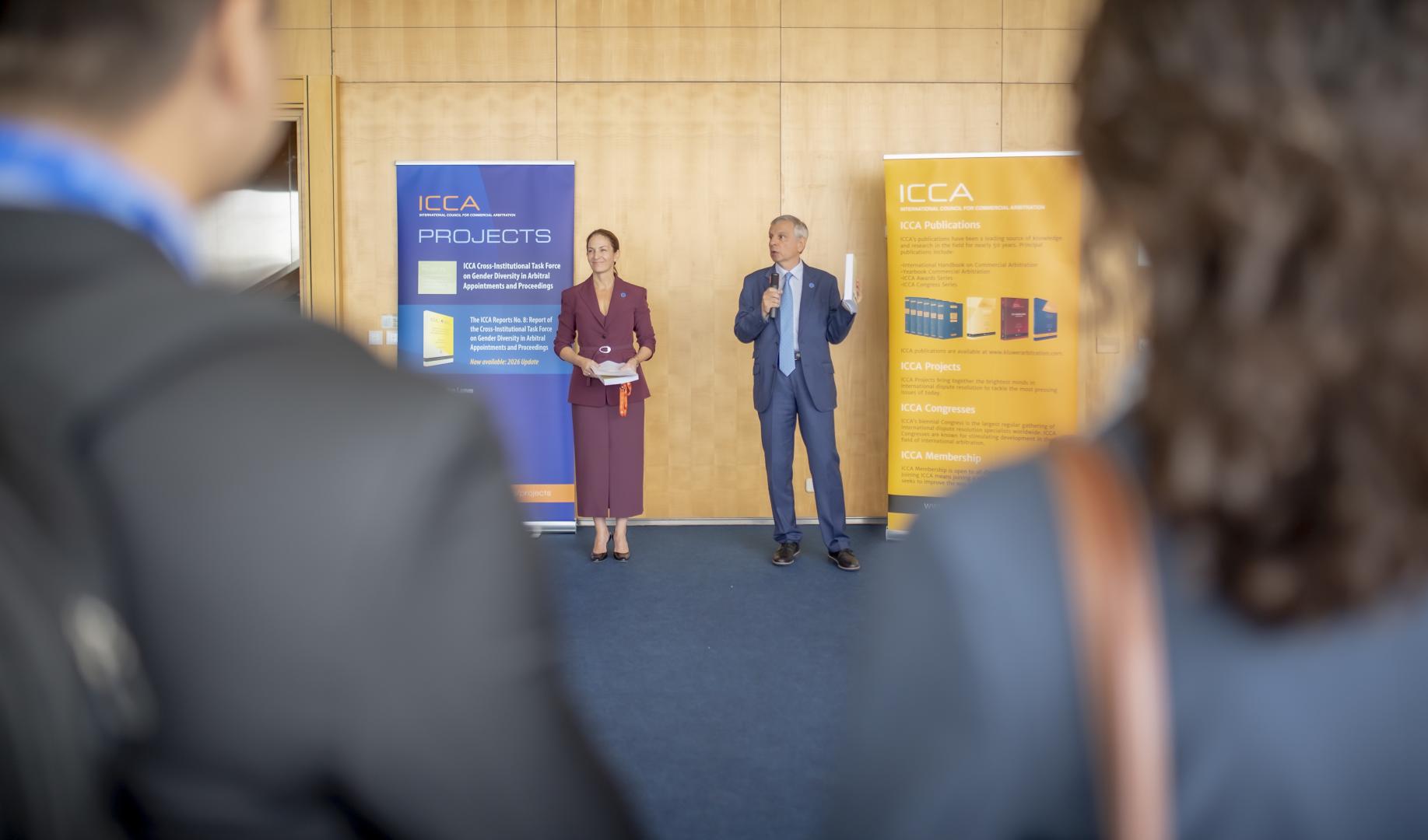
📷 ICCA Inclusiveness Committee Member Dyalá Jiménez and Immediate-Past ICCA President Stanimir Alexandrov celebrate the launch to the 2026 Update to the Report at the ICCA 2026 Madrid Congress.